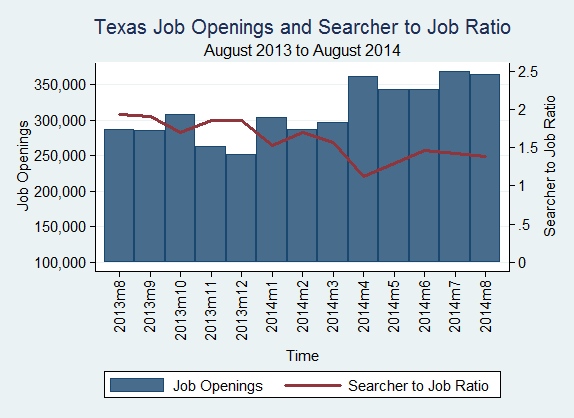
Texas hydro-fracturing job openings decreased from July to August

petroleum engineer

The number of job openings in Texas for “petroleum engineers” and “geological and petroleum technicians” decreased from 782 in July 2014 to 648 in August 2014, while the searcher-to-job opening ratio increased from 1.1 to 1.3 in the same span.

petro_engineer_2014_08The number of job openings in Texas for “derrick operators” and “roustabouts” decreased from 368 in July 2014 to 282 in August 2014, while the searcher-to-job opening ratio increased from 1.7 to 2.6 in the same span.
roustabout_2014_08

Source: BLS

Image source: http://wonderfulengineering.com/what-is-petroleum-engineering/

Texas job openings by major occupational group

Texas August 2014

Total number of job openings and median searcher-to-job ratio across all MSAs (metropolitan statistical areas) for each major occupational group in Texas in August 2014.

Occupation Job Openings Searcher-To-Job Ratio
Management, business, and financial occupations 91,231 0.82
Professional and related occupations 139,533 1.44
Office and administrative support occupations 82,231 1.75
Sales and related occupations 47,483 2.00
Installation, maintenance, and repair occupations 24,023 2.16
Service occupations 108,172 2.32
Transportation and material moving occupations 28,741 2.86
Farming, fishing, and forestry occupations 1,765 3.65
Production occupations 27,017 4.53
Construction and extraction occupations 16,640 8.20

Source: BLS

Recalculating a jury award in a California Med Mal case

The Medical Injury Compensation Reform Act (MICRA) of 1975 was a statute enacted by the California Legislature in August 1975.  One of the provisions of the statute was to allow doctors to make periodic payments of awards in Med Mal cases.
Accordingly, in California in those instances, the jury is required to award/come back with both un-discounted and present value discounted amounts. If the defendant chooses to make periodic payments, then the un-discounted award amounts come into play.
In a recent the jury came back with an award but only mentioned present value numbers and no future values.
The Court and the attorneys agreed that it was better to not send the jury back to give a future value award.  Instead they decided to have the economists figure out what the undiscounted future values are based on the present value numbers that the jury awarded.
So the following approach was offered.
Both economists used the ratio of the award to the present value numbers to future value numbers to back into the jury’s implicit undiscounted amount.  For example, if the award was about 25% more than what testified to, then the future value was increased by the same percentage.
So for example if  you two both used a 3% rate and calculated the present value of a loss over 10 years, the PV factor is 8.5302 (old school approach using tables!).  If you calculated a $50,000 loss and the opposing expert calculated a $75,000 loss that would give you present value amounts of $426,510 and $639,765 respectively.
If the jury came back with a present value number in between the two experts then this would be about $539,137,. The annual loss that the jury implicitly used to arrive at the $533,137 figure is about $62,500.  The annual loss number is right in the middle of the two experts.
Annual Loss PV factor PV of Award
Economist 1  $        50,000 8.5302  $        426,510
Economist 2  $        75,000 8.5302  $        639,765
Jury  $  533,137.50
Your 50% Guess (based on Jury award)  $    62,500.0 8.5302  $        533,138

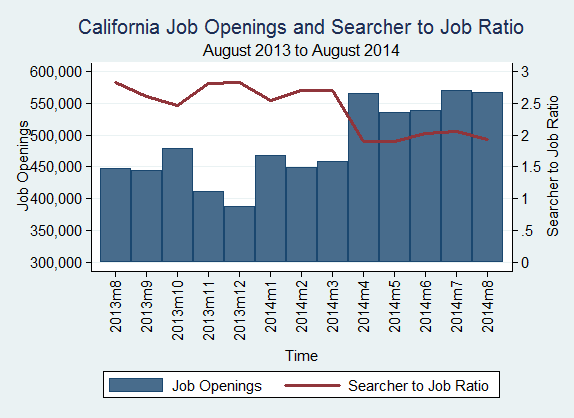
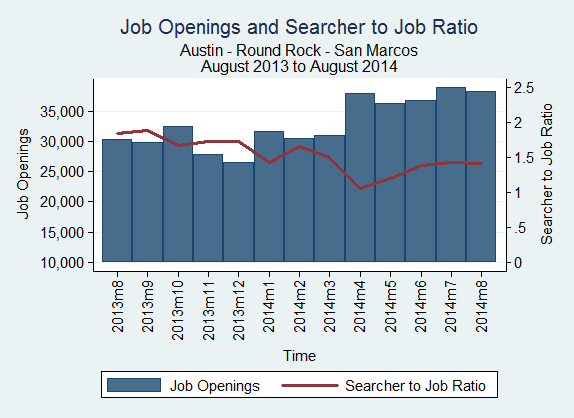
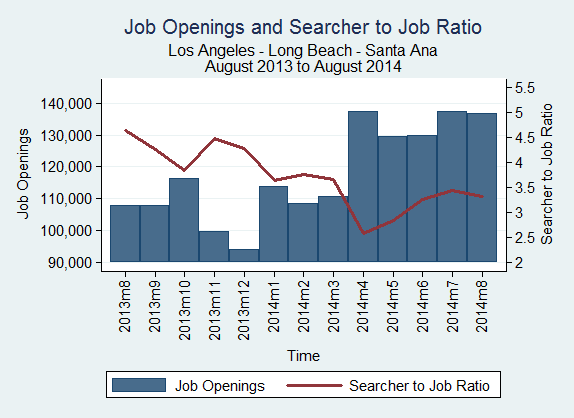
California and Texas both saw greater decrease in job openings than US for August

California and Texas both experienced a greater decrease in job openings than the US for the month of August.

August 2014

Location Total_Openings Monthly_Change Yearly_Change
CA 566,834 -0.67% 27.78%
TX 364,236 -1.23% 27.59%
US 4,543,314 -0.56% 27.82%

Source: BLS

Innovation sector jobs decreased in both CA and TX for the month of August

California experienced a decrease of 1,011 innovation job openings from July 2014 to August 2014, a decrease of 4.02%. Texas experienced a decrease of 456 innovation job openings from July 2014 to August 2014, a decrease of 3.45%.

innovation

State Total_Openings Monthly_Change Yearly_Change
CA 24,132 -4.02% 29.71%
TX 12,762 -3.45% 30.67%

Innovation jobs definition: http://www.employstats.com/blog/2014/09/26/1233/

Source: BLS

Image source: http://www.bizjournals.com/sacramento/news/2013/09/23/symposium-innovation-ecosystems-jobs-wea.html

Return on education, student loan interest and repayment periods

Education remains the best investment around.  One economic question that always comes up is: are student loans worth it?  That is, should I take out a loan (if that is the only way I can attend college)?


The quick answer is usually yes for attendance at a reputable institution.  So how do you calculate the return on education investment?  Generally, the calculation subtracts the explicit cost of attendance (tuition, fees, books, and student loan costs both current and future) and the opportunity cost of attendance (that is the job you could have gotten) from the added income that the person will make over their working life due to the education investment.

See: https://studentaid.ed.gov/repay-loans/understand/plans

Student loans come in two forms: subsidized and unsubsidized.  Subsidized loans are usually financial need based; unsubsidized loans are not.  Both types of loans have requirements regarding school attendance (usually at least half time).

The type of loan also impacts the interest rate; higher the interest rate the lower the return on education.

Student loan repayment periods also vary. Nowadays, student loan time periods range from 10 to 25 years.  There are programs that allow the repayment to increase over time, change with income, and ones that are fixed over time.

Generally, the shorter the repayment time period, the higher the return on the education investment.  In short, less loan interest is paid on a shorter loan period.