Percentages, rates of increases, and change factors: what’s the difference?

One question that comes up all the time in our work is what is the difference between a percentage change and a rate of increase?  Answer:  They are the same idea, just expressed differently.  For instance, if you say the price of oil increased  by 100% that is the same as saying that the price of oil doubled.

So mathematically, the 100% increase is equal to a 2.0 times increase.  So generally, you can subtract one from a change factor (i.e. 2.0 times higher) to get the percentage increase.

 

Median rent and housing prices on average increased for three largest Eagle Ford Shale MSAs

housing

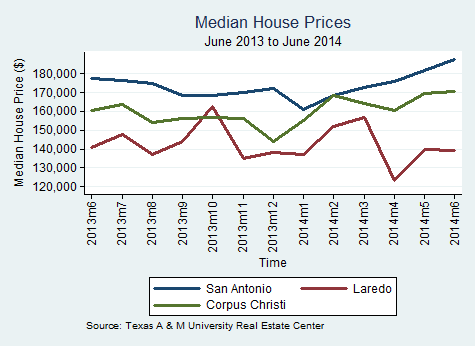
Median rent rose in both San Antonio and Laredo from May 2014 to June 2014; it fell in Corpus Christi during the same span.rent_2014_06 Median house prices for San Antonio and Corpus Christi rose from May 2014 to June 2014. Median house prices for Laredo fell from May 2014 to June 2014. house_2014_06Image source: http://www.asemooni.com/news/economic-news/the-president-agreed-with-the-increase-in-housing

Business closure rates study

SBA study on business closure rates (as opposed to failure) provides some insights on business survival rates. In a 2003 study, the SBA found 50 % survived, 17% were successful but closed and 33% closed and unsuccessful after 4-5 years.

The study found 39.5% survived after 6 years.

Source:
Headd, Brian, “Redefining Business Success: Distinguishing Between Closure and Failure,” Small Business Economics, 21, 2003, pp. 51-61, reprinted by the Office of Advocacy, U.S. Small Business Administration, 2003.

Texas hydro-fracturing job openings decreased from May 2014 to June 2014

petroleum engineer The number of job openings in Texas for “petroleum engineers” and “geological and petroleum technicians” decreased from 640 in May 2014 to 622 in June 2014, while the searcher-to-job opening ratio increased from 0.90 to 1.4 in the same span.petro_engineer_2014_06 The number of job openings in Texas for “derrick operators” and “roustabouts” decreased from 283 in May 2014 to 270 in June 2014, while the searcher-to-job opening ratio increased from 2.63 to 3.01 in the same span. roustabout_2014_06

Image source: http://wonderfulengineering.com/what-is-petroleum-engineering/.

What attracts people and employers to some cities but not others ?

Economies of agglomeration

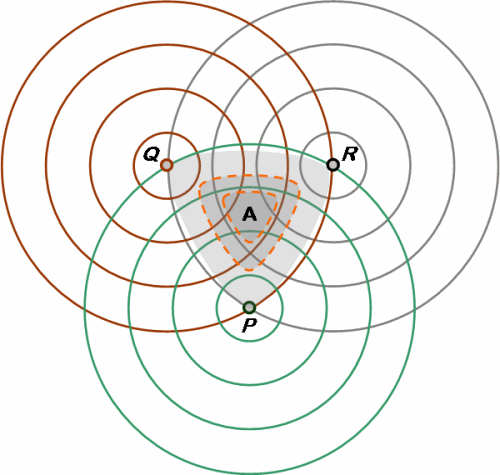
agglomerationeconomiesA:Economies of agglomeration

Prof. Moretti in his book ‘Geography of Jobs’  identifies three things,  that economists collectively refer to as the forces of agglomeration, as driving factors.

One is the size and thickness of the specific labor markets. Thick markets allow workers and employers to make better and better informed and longer lasting employer matches.

Two is the ecosystem. Effectively, Moretti shows how the soil that we are planted with our employers is a huge contributor to our individual success. For instance he resents several interesting examples that show how both smart and not-so smart people benefit from being around smart people.

The number of cited patents example is particularly interesting and telling. He also makes it clear that having access to funding is made easier when the cities’ ecosystem is better developed.

Three are knowledge spilling overs.


Texas job openings by major occupational group

Texas June 2014

Total number of job openings and median searcher-to-job ratio across all MSAs (metropolitan statistical areas) for each major occupational group in Texas in May 2014.

Occupation openings s2jratio
Management, business, and financial occupations 54098 0.7
Professional and related occupations 77613 1.19
Office and administrative support occupations 52093 1.2
Installation, maintenance, and repair occupations 16796 1.42
Service occupations 61409 1.65
Sales and related occupations 26907 1.76
Farming, fishing, and forestry occupations 888 2.24
Transportation and material moving occupations 17950 2.28
Production occupations 20146 2.7
Construction and extraction occupations 15616 5.01

Texas job openings by major occupational group

Texas June 2014

Total number of job openings and median searcher-to-job ratio across all MSAs (metropolitan statistical areas) for each major occupational group in Texas in May 2014.

Occupation openings s2jratio
Management, business, and financial occupations 54098 0.7
Professional and related occupations 77613 1.19
Office and administrative support occupations 52093 1.2
Installation, maintenance, and repair occupations 16796 1.42
Service occupations 61409 1.65
Sales and related occupations 26907 1.76
Farming, fishing, and forestry occupations 888 2.24
Transportation and material moving occupations 17950 2.28
Production occupations 20146 2.7
Construction and extraction occupations 15616 5.01