Top 3 occupations with the most new job openings in Texas for Dec

The top three occupations with the most new job openings in Texas for the month of December were Elementary and Middle School Teachers with 404 new openings, Registered Nurses with 267 new openings, and Nursing, Psychiatric, and home Health Aides with 212 new openings.

December 2014

Occupation Total_Openings New_Openings
Nursing, Psychiatric, and Home Health Aides 2,332 212
Registered Nurses 2,508 267
Elementary and Middle School Teachers 3,452 404

Source: BLS

California RN’s, PA’s, and therapists see increase in job openings from Nov to Dec

healthcare

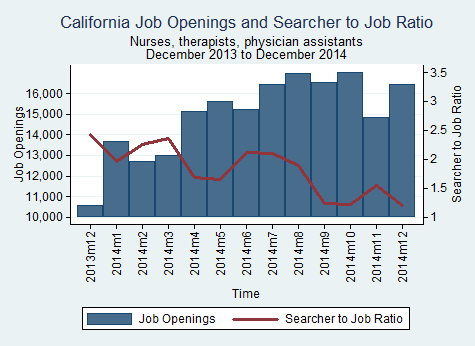
The number of job openings in California for nurses, therapists, and physician assistants increased from 14,866 in November 2014 to 16,429 in December 2014. The searcher-to-job opening ratio decreased from 1.54 to 1.20 in the same span.

nurse_2014_12

Source: BLS

Image source: http://pediatric-nurse-practitioners.blogspot.com/2012/12/top-5-cardiac-care-nursing-jobs-for-we.html

Steward and Gaylor (2015) Matched CPS Sample Sizes for 1993-2013 time period

Big Data. Bureau of Labor Statistics. Survey data. Employment Big Data.  Those are all things that calculating worklife expectancy for U.S. workers requires.  Worklife expectancy is similar to life expectancy and indicates how long a person can be expected to be active in the workforce over their working life.  The worklife expectancy figure takes into account the anticipated to time out of the market due to unemployment, voluntary leaves, attrition, etc.

Overall the goal of our recent work is to update the Millimet et al (2002) worklife expectancy paper and account for more recent CPS data.

The data for all years is shown below.  Ultimately there were over 590,000 data points used in the analysis.

Table 2.  Matched CPS Sample Sizes 1993-2013
Female Male
Year Less than High School High School Some College College Less than High School High School Some College College Total
1993 3,766 7,326 4,898 3,452 3,376 5,619 4,280 3,935 36,652
1994 3,539 7,019 5,357 3,619 3,097 5,477 4,411 4,013 36,532
1995 3,082 6,161 5,086 3,545 2,664 4,815 4,086 3,938 33,377
1997 3,079 6,172 4,771 3,488 2,723 4,857 3,926 3,723 32,739
1998 2,839 6,113 4,873 3,672 2,694 4,952 3,995 3,834 32,972
1999 2,709 6,027 4,987 3,770 2,513 4,830 4,134 3,923 32,893
2000 2,692 5,930 5,009 3,915 2,463 4,899 4,052 4,204 33,164
2001 2,545 5,806 4,971 3,901 2,458 4,919 4,232 4,016 32,848
2003 1,096 3,218 2,579 2,411 1,019 2,701 2,122 2,470 17,616
2004 2,579 6,372 5,803 5,009 2,394 5,307 4,745 4,819 37,028
2005 2,039 5,378 5,146 4,673 1,867 4,632 4,270 4,285 32,290
2006 2,297 5,500 5,608 4,657 2,131 4,953 4,263 4,389 33,798
2007 2,147 5,730 5,466 5,060 2,076 5,133 4,344 4,592 34,548
2008 2,159 5,659 5,787 5,281 2,040 5,212 4,593 4,826 35,557
2009 2,027 5,637 5,780 5,556 2,023 5,062 4,776 4,976 35,837
2011 1,845 4,844 5,106 5,136 1,786 4,603 4,176 4,432 31,928
2012 1,733 4,849 4,930 4,956 1,779 4,693 4,151 4,616 31,707
2013 1,658 4,542 5,061 5,109 1,668 4,579 4,271 4,650 31,538
Total 43,831 102,283 91,218 77,210 40,771 87,243 74,827 75,641 593,024

Notes:

The CPS data was matched using the algorithm similar to Millimet et al (2002) and Peracchi and Welch (1995).  Households in rotation 1-4 were matched using the household identifier number to the same household in rotations 5-8 of the following year. Individuals had to have the same sex, race and be a year older in rotation 5-8 to be determined a match.


California innovation job openings decreased from Nov to Dec

innovation

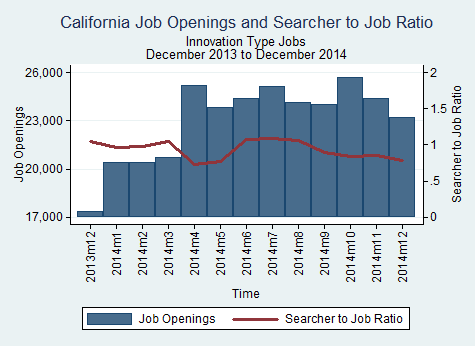
The number of job openings in California for “Innovation Type Jobs” decreased from 24,404 in November 2014 to 23,218 in December 2014. The searcher-to-job opening ratio also decreased from 0.86 to 0.79 in the same span.

Innovation jobs definition: http://www.employstats.com/blog/2014/09/26/1233/

innovation_2014_12

Image source: http://www.bizjournals.com/sacramento/news/2013/09/23/symposium-innovation-ecosystems-jobs-wea.html

California STEM job openings increased from Nov to Dec

stem

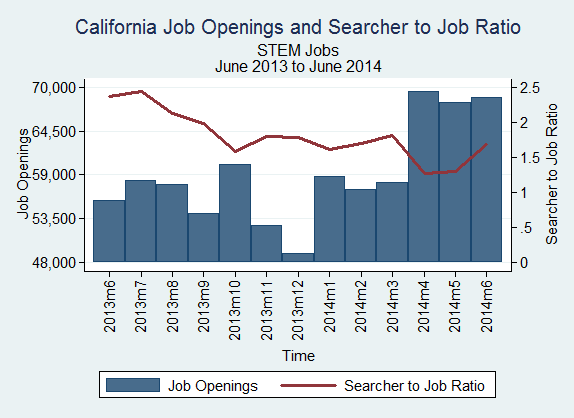
The number of job openings in California for STEM (science, technology, engineering, math) jobs increased from 66,268 in November 2014 to 67,091 in December 2014. The searcher-to-job opening ratio decreased from 1.27 to 1.12 in the same span.

Our definition of STEM jobs: http://www.employstats.com/blog/2014/09/19/growing-national-interest-in-stem-fields-has-focused-our-research/

STEM_2014_12

Source: BLS

Image source: http://fairmountinc.com/help-wanted-1-2-million-good-paying-jobs-available/

Texas innovation job openings decreased from Nov to Dec

innovation

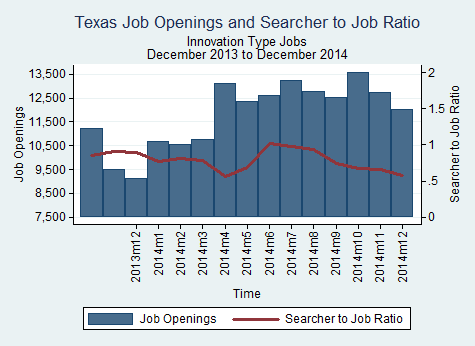
The number of job openings in Texas for “Innovation Type Jobs” decreased from 12,748 in November 2014 to 12,021 in December 2014. The searcher-to-job opening ratio also decreased from 0.66 to 0.58 in the same span.

innovation_2014_12

Innovation jobs definition: http://www.employstats.com/blog/2014/09/26/1233/

Source: BLS

Image source: http://www.americas.gecapital.com/insight-and-ideas/capital-perspectives/innovation-secrets-of-steve-jobs

FLSA OT report for individuals working in automotive body and related repair occupations

In this post, we look at the weekly overtime (OT) hours typically worked by those who work in automotive body and related repair occupations.

Many of the employees that work in these jobs are not exempt from FLSA overtime pay and earn 1.5 times pay for hours worked over 40 in a given week.

The tabulations below are based on U.S. BLS survey data. The BLS job title groups are insightful, generally containing more specific job titles with similar knowledge, skills, and abilities (KSA), but can be more broad than a particular company’s job title listing. Also, some companies may have the job title listed here as exempt from FLSA or state OT due to their specific job assignments. The BLS does not make a distinction as to if the job title is exempt or non-exempt from OT.

Occupational Group Title Percent of OT Workers Average Hours of OT 1 out of every 4 (25%) OT workers works at least
Automotive Body and Related Repairers 26.92% 13.3 hours 60 hours

U.S. BLS data inddicates that approximately 26.92% of automotive body and related repairers work overtime hours in a given week.  On average, these workers that have FLSA overtime work approximately 13.3 hours a week in OT. The average regular or straight time pay rate of theise workers in the U.S. is approximately 18.77 an hour.  The average FLSA OT rate, not including supplemental pay such as non-discretionary bonus pay is 28.16 an hour.

Source: BLS (CPS March)

Texas STEM job openings decreased from Nov to Dec

STEM logo

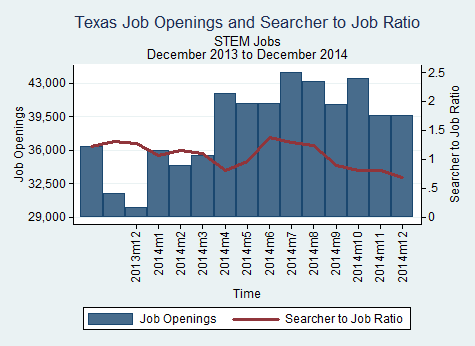
The number of job openings in Texas for STEM (science, technology, engineering, math) jobs decreased from 39,659 in November to 39,570 in December 2014. The searcher-to-job opening ratio also decreased from 0.81 to 0.68 in the same span.

Our definition of STEM jobs: http://www.employstats.com/blog/2014/09/19/growing-national-interest-in-stem-fields-has-focused-our-research/

STEM_2014_12


Source: BLS

Image source: http://projecttomorrowblog.blogspot.com/2013/11/i-am-scientist.html

What’s a pension band?

A pension band is a figure that is used when calculating the monthly benefit for a defined benefit pension program.  A pension band figure, which is typically changes each year, is generally a dollar amount that the person will receive monthly for each year of service with the employer when they retire..  The pension band generally varies by job title/grade level/occupation covered by a pension plan.. Once assigned, the job title, grade level and occupation will generally remain in that band unless the job title, grade level and occupation (by location) are later reclassified to a different pension band.

Example of Basic Monthly Benefit Calculation.

The following hypothetical example shows how a basic monthly benefit is calculated assuming: •

You are in pension band 115.

The monthly benefit for pension band 115 is $55.49

In this example, the monthly benefit for a person with 30 years of credited service would be

Monthly benefit for pension band 115 ($ 55.49 Multiplied by 30 years of net credited service x 30 Basic monthly benefit =  $1,664.70

Comparsion of CPS matched data sets – Millmet et al (2002) to Steward and Gaylor (2015)

Big Data. Bureau of Labor Statistics. Survey data. Employment Big Data.  Those are all things that calculating worklife expectancy for U.S. workers requires.  Worklife expectancy is similar to life expectancy and indicates how long a person can be expected to be active in the workforce over their working life.  The worklife expectancy figure takes into account the anticipated to time out of the market due to unemployment, voluntary leaves, attrition, etc.

Overall the goal of our recent work is to update the Millimet et al (2002) worklife expectancy paper and account for more recent CPS data. Their paper uses data from  the 1992 to 2000 time period. Our goal is to update that paper using data from 2000 to 2013. The main goal of the paper is to see if estimating the Millimet et al (2002) econometric worklife models with more recent data changes the results in the 2002 paper in any substantive way.


Our approach is two fold.  First we matched the BLS data cohorts based on the Millimet et al. (2002) and Peracchi and Welch (1995) papers. In a nutshell the CPS matching routine involves matching incoming and outgoing cohorts across a given year.  Once the data is matched, we then look at the work status of the individuals to determine if they were active or in active across the year that they were interviewed by the BLS. . We were able to create a match CPS data set of 201,797 individuals where as the Millimet et al. (2002) found 200,916 matched individuals.

Table 1. Comparsion of CPS cohort matched data sets
Year Millimet et al.  (2002) Steward and Gaylor (2015)
1992/93 37,709 36,652
1994/95 34,418 33,377
1996/97 31,691 32,739
1997/98 32,276 32,972
1998/99 32,083 32,893
1999/2000 32,739 33,164
Total 200,916 201,797

Notes:

The CPS data was matched using the algorithm similar to Millimet et al (2002) and Peracchi and Welch (1995).  Households in rotation 1-4 were matched using the household identifier number to the same household in rotations 5-8 of the following year. Individuals had to have the same sex, race and be a year older in rotation 5-8 to be determined a match.