The following describes the approach used by Millimet et al (2002) to estimate U.S. worker worklife expectancy. The pdf version can be found here: Millimet (2002) Methodology Description
Methodology
First, transition probabilities are obtained from a two state labor market econometric model. The two labor market states are active and inactive in the workforce. The transition probabilities are the probabilities of going from one labor market state to another, such as active in one period and inactive in the next period. There are four such transition probabilities (Active-Active, Active-Inactive, Inactive-Active, Inactive-Inactive). The transition probabilities are obtained from the conditional probabilities estimated using a standard logit frame work. The logit model states:

Where y is equal to 1 if the individual is active and y equals 0 if the individual is inactive in the workforce during the period. Logit regression models are estimated separately for active and inactive individuals. For example, for a person who is initially active, the two estimated transition probabilities (Active to Active and Active to Inactive) equations are:

The estimated transition probabilities for persons who are initially inactive are estimated in a similar manner. The transition probabilities/conditional probabilities are used to construct predicted transition probabilities for each individual in the data set.
The average of the individual predicted probabilities for each age are ultimately used to calculate the transition probabilities in the Millimet et al. (2002) econometric worklife model. The average predicted transition probabilities at each age are:

In the calculation the averages are weighted by the CPS weights. Also anine year moving average is used to smooth out the transition probabilities.
The worklife expectancy at each age can be determined recursively. Specifically, if there is an assumed terminal year (T+1) in which no one is in the workforce, then the worklife expectancy for each age prior can be determined by working backwards in the probability tree. For instance at the terminal year, the individual’s worklife in the terminal year is the worklife probability in that terminal year. For example, assume that after age 80 no individuals are active in the work force. In this example, the probability that a person who is active at age 79 will be active at age 80, is the worklife expectancy for the individual at age 79. As described below this fact allows the worklife for all ages to be determined recursively using the transition probabilities obtained from the logistic regression models.
So specifically, the worklife () is the probability that the person active at time T remains active at the beginning of period T+1 (or end of T). It is assumed that no one is active after time period T+1. Similarly, the worklife () is the probability that the person inactive at time T is active at the beginning of period T+1 (or the end of T). Accordingly, there are multiples ways that a person at the end of time period T-1 can arrive at being active or inactive at the end of T, the terminal year. For instance, the person could be active in T-1 and then active in T. The transition probability for the is person is: . Alternately the person could be inactive in T-1 and active in T. The transition probability for this person is Two similar transition probabilities can be obtained for persons who are initially inactive at time T-1.
Using the worklife expectancies( and ) for the year prior to the terminal year can be calculated using the four transition probabilities described above. Specifically the worklife expectancies are as follows.
l
The 0.5 factor is included to account for the assumption that all transitions are assumed to occur at mid year.
Using this methodology, the worklife expectancy for each year prior to the terminal year in a recursively fashion.
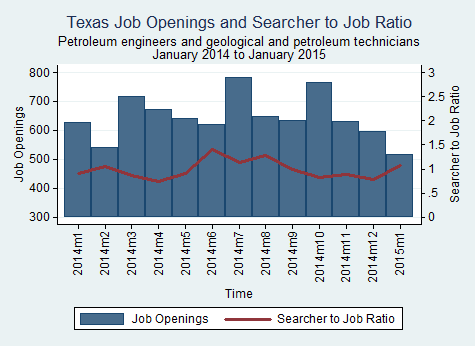
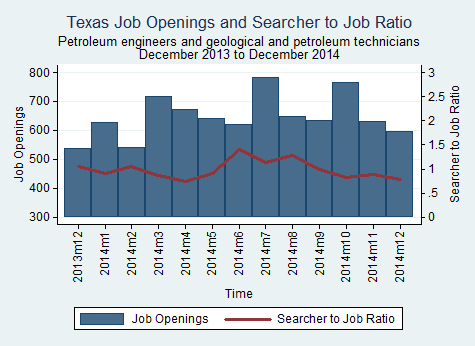
 The number of job openings in Texas for “petroleum engineers” and “geological and petroleum technicians” decreased from 595 in December 2014 to 517 in January 2015, while the searcher-to-job opening ratio also increased from 0.78 to 1.07 in the same span.