The move by private employers to make salary information public

Some employers, both private and public, are moving towards making employee’s salaries public.  “Making Pay Public” by Tamara Lytle , in HR Magazine, September 2014. discusses the recent trend of employers making employee’s salaries more open.

Some employers such as, Buffer, are going so far as to not only making their salaries public, but are also providing details on the decision process by which the employee’s  salary was determined. For example, Buffer’s salary formula has set factors that take into account the employee’s job type, seniority, experience, location, and equity versus salary choice.

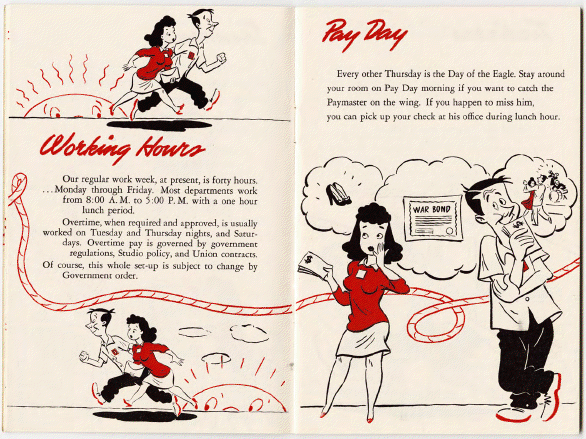
In the formula, engineers and designers have a base salary of $60.000 while content crafters have a base salary of $50,000.  Employees in Austin receive a $12,000 salary kicker, while employees in San Franciso receive a $22,000 salary kicker.   Buffer’s (and other’s) approach to salary is clearly a different approach from how some employers had pay discussions in the past.

A 1943 HR Manual from Disney:


Growing importance in STEM fields has focused our research

stem

STEM fields are those that include science, technology, engineering, or mathematics. We have recently focused our research to assess the economy in these growing fields for 21st century. Below is our list of STEM occupations we use in our research:

-Insurance underwriters

-Financial specialists, all other

-Computer and information research scientists

-Computer systems analysts

-Information security analysts

-Computer programmers

-Software developers, applications and systems software

-Web developers

-Computer support specialists

-Data base administrators

-Computer network architects

-Computer occupations, all other

-Actuaries

-Operations research analysts

-Mathematicians, statisticians, and miscellaneous mathematical science occupations

-Architects, except naval

-Surveyors, cartographers, and photogrammetrists

-Aerospace engineers

-Agricultural and biomedical engineers

-Chemical engineers

-Civil engineers

-Computer hardware engineers

-Electrical and electronic engineers

-Environmental engineers

-Industrial engineers, including health and safety

-Marine engineers and naval architects

-Materials engineers

-Mining and geological engineers

-Nuclear engineers

-Petroleum engineers

-Engineers, all other

-Drafters

-Engineering technicians, except drafters

-Surveying and mapping technicians

-Agricultural and food scientists

-Biological scientists

-Conservation scientists and foresters

-Medical scientists and life scientists, all other

-Astronomers and physicists

-Atmospheric and space scientists

-Chemists and materials scientists

-Environmental scientists, all other

-Economists

-Psychologists

-Urban and regional planners

-Miscellaneous social scientists, including survey researchers and sociologists

-Agricultural and food science technicians

-Biological technicians

-Chemical technicians

-Geological and petroleum technicians

-Miscellaneous life, physical, and social science technicians

-Chiropractors

-Dentists

-Dietitians and nutritionists

-Optometrists

-Pharmacists

-Physicians and surgeons

-Physicians assistants

-Registered nurses

-Audiologists

-Occupational therapists

-Physical therapists

-Radiation therapists

-Recreational therapists

-Respiratory therapists

-Speech-language pathologists

-Exercise physiologists and therapists, all other

-Veterinarians

-Registered nurses

-Nurse Anesthetists

-Nurse midwives and nurse practitioners

-Health diagnosing treating practitioners, all other

-Clinical laboratory technologists and technicians

-Dental hygienists

-Diagnostic related technologists and technicians

-Emergency medical technicians and paramedics

-Health diagnosing and treating practitioner support technicians

-Massage therapists

-Dental assistants

-Medical assistants

-Medical transcriptionists

-Pharmacy aides

-Veterinary assistants and laboratory animal caretakers

-Phlebotomists

-Miscellaneous healthcare support occupations, including medical equipment preparers

-Sales engineers

-Sale representatives, wholesale and manufacturing (need technical and scientific products)

-Avionics technicians

-Aircraft mechanics and service technicians

-Stationary engineers and boiler operators

-Medical, dental, and ophthalmic laboratory technicians

-Aircraft pilots and flight engineers

Source: BLS

Image source: http://fairmountinc.com/help-wanted-1-2-million-good-paying-jobs-available/

California and Texas both saw increase in job openings in July 2014

California

California experienced an increase of 32,338 job openings from June 2014 to July 2014, a 6.01% increase.

Date Total_Openings Monthly_Change Yearly_Change
Jul-14 570,648 6.01% 27.68%
Jun-14 538,310 0.55% 16.09%
May-14 535,368 -5.24% 20.85%
Apr-14 565,001 23.20% 26.68%
Mar-14 458,591 2.14% -2.59%
Feb-14 448,997 -4.13% 0.79%
Jan-14 468,361 20.57% 11.64%
Dec-13 388,443 -5.47% -9.36%
Nov-13 410,918 -14.15% 16.93%
Oct-13 478,665 7.91% 24.94%
Sep-13 443,593 -0.75% 0.01%
Aug-13 446,950 -3.61% 8.97%

Texas

Texas experienced an increase of 25,267 job openings from June 2014 to July 2014, a 7.36% increase.

Date Total_Openings Monthly_Change Yearly_Change
Jul-14 368,784 7.36% 28.75%
Jun-14 343,517 0.21% 18.88%
May-14 342,800 -5.20% 20.03%
Apr-14 361,597 22.06% 25.80%
Mar-14 296,241 3.08% -1.95%
Feb-14 287,386 -5.31% 1.30%
Jan-14 303,498 20.51% 12.47%
Dec-13 251,841 -4.38% -8.61%
Nov-13 263,377 -14.41% 16.67%
Oct-13 307,730 7.80% 25.44%
Sep-13 285,468 -0.34% 0.57%
Aug-13 286,439 -0.88% 8.61%

Source: BLS

Do employee tips get rolled into the regular rate of pay for OT purposes?

The short answer is:  Generally no they do not get rolled into the regular rate of pay for the purpose of calculating an employee’s overtime (OT).  However, calculating the applicable regular rate of pay to be used in calculating overtime for a tip employee is a little different from that of non-tipped employees.

To illustrate, consider the following Midwestern restaurant chain.  The manager of one of the  regions is reviewing its overtime policy for its tipped employees.

FLSA allows tipped employees to be paid less than the minimum wage. In this state, like the federal law, tipped employees are paid a minimum of $2.13 per hour. In the state employers.  Employers of tipped employees can claim a tip credit up to the difference between the cash payment requirement of $2.13 and the minimum wage of $7.25.  So in this state the employer can take a maximum tip credit of $5.12 ($7.25 – $2.13).

The restaurant pays its employees a rate less than minimum. (The employees of course continue to work at the location because of the tips that they earn as waiters and servers!) The restaurant claims a tip credit of $5.12 per hour.   In the chain, the restaurant employees retain all their tips as required by FLSA, but they do take part in a valid tip pooling arrangement with other employees (bussers and service bartenders in this case example)  who regularly receive tips.

How NOT to calculate the OT rate for its tipped employees:

Unlike its non-tipped employees, the restaurant can not simply pay its tipped employees an overtime rate equal to 1.5 times the employees hourly rate.  That is the employer can not simply pay $3.20 per hour ($2.13 x 1.5) for the employees OT.

How to calculate the OT rate for its tipped employees:

So in this example, the employee’s OT rate should by $5.76 for hours worked over 40 in a week.

Fed. Min. Wage: $7.25

OT rate: 1.5

OT Hourly Rate:  $10.88 ($7.25 x 1.5)

minus employer tip credit: $5.12 ($7.25-$2.13)

OT rate for tipped employees : $5.76

So in practice, the actual OT rate will vary by state since different states have different minimums. However, in general the calculation follows as above.

Resources:

Fact Sheet #15: Tipped Employees Under the Fair Labor Standards Act (FLSA) 

California Tipped Employees


4 largest California MSAs see increase in job openings from May 2014 to June 2014

All 4 of the largest MSAs (metropolitan statistical areas) in California experienced an increase in job openings for the month of June.

Los Angeles-Long Beach-Santa Ana

The Los Angeles-Long Beach-Santa Ana MSA experienced an increase of 242 job openings in June 2014, a 0.19% change from May 2014.

Date Job Openings pct_mnthly_chg pct_yrly_chg
Jul-13 111931 15.94752
Aug-13 107714 -3.76747 15.94752
Sep-13 107881 0.155095 15.94752
Oct-13 116232 7.74074 15.94752
Nov-13 99534 -14.3665 15.94752
Dec-13 94076 -5.48352 15.94752
Jan-14 113912 21.08539 15.94752
Feb-14 108563 -4.69606 15.94752
Mar-14 110825 2.083839 15.94752
Apr-14 137352 23.93568 15.94752
May-14 129540 -5.68721 15.94752
Jun-14 129782 0.186349 15.94752

San Francisco-Oakland-Fremont

The San Francisco-Oakland-Fremont MSA experienced an increase of 206 job openings in June 2014, a 0.42% change from May 2014.

Date Job Openings pct_mnthly_chg pct_yrly_chg
Jul-13 42443 15.77961
Aug-13 41173 -2.99164 15.77961
Sep-13 41049 -0.303 15.77961
Oct-13 43869 6.870093 15.77961
Nov-13 37771 -13.9 15.77961
Dec-13 35578 -5.80724 15.77961
Jan-14 42940 20.69461 15.77961
Feb-14 40977 -4.57116 15.77961
Mar-14 41811 2.033991 15.77961
Apr-14 51583 23.37293 15.77961
May-14 48935 -5.13467 15.77961
Jun-14 49141 0.420907 15.77961

Riverside-San Bernardino-Ontario

The Riverside-San Bernardino-Ontario MSA experienced an increase of 327 job openings in June 2014, a 0.71% change from May 2014.

Date Job Openings pct_mnthly_chg pct_yrly_chg
Jul-13 39944 16.86667
Aug-13 38522 -3.56153 16.86667
Sep-13 38068 -1.17874 16.86667
Oct-13 41147 8.089971 16.86667
Nov-13 35358 -14.0698 16.86667
Dec-13 33336 -5.71823 16.86667
Jan-14 40242 20.71779 16.86667
Feb-14 38895 -3.3472 16.86667
Mar-14 39795 2.312312 16.86667
Apr-14 48989 23.10446 16.86667
May-14 46354 -5.3783 16.86667
Jun-14 46681 0.705416 16.86667

San Diego-Carlsbad-San Marcos

The San Diego-Carlsbad-San Marcos MSA experienced an increase of 430 job openings in June 2014, a 0.65% change from May 2014.

Date Job Openings pct_mnthly_chg pct_yrly_chg
Jul-13 56647 16.88855
Aug-13 54499 -3.79081 16.88855
Sep-13 54100 -0.73243 16.88855
Oct-13 58926 8.919652 16.88855
Nov-13 50552 -14.2098 16.88855
Dec-13 47699 -5.64362 16.88855
Jan-14 57523 20.5941 16.88855
Feb-14 55345 -3.7853 16.88855
Mar-14 56460 2.013243 16.88855
Apr-14 69647 23.35666 16.88855
May-14 65783 -5.54723 16.88855
Jun-14 66213 0.654083 16.88855

Source: BLS

California RN’s, PA’s, and therapists see decrease in job openings from May 2014 to June 2014

healthcare nurse_2014_06


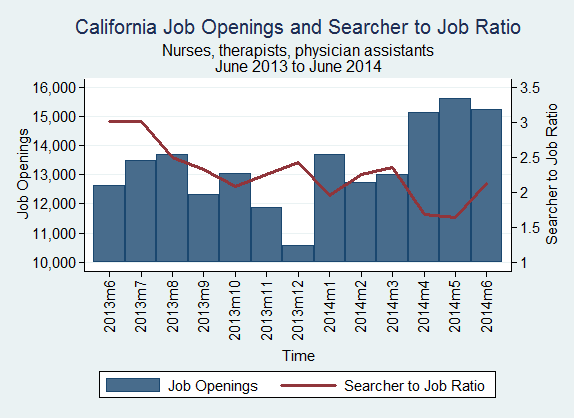
The number of job openings in California for nurses, therapists, and physician assistants decreased from 15,620 in May 2014 to 15,253 in May 2014. The searcher-to-job opening ratio increased from 1.64 to 2.12 in the same span. Image source: http://pediatric-nurse-practitioners.blogspot.com/2012/12/top-5-cardiac-care-nursing-jobs-for-we.html

California STEM job openings increased from May 2014 to June 2014

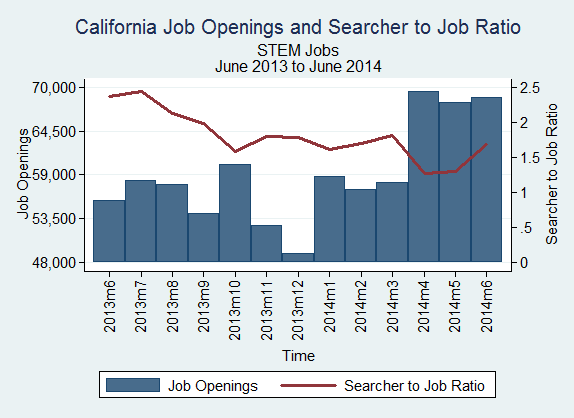
stemSTEM_2014_06The number of job openings in California for STEM (science, technology, engineering, math) jobs from 68,073 in May 2014 to 68,752 in June 2014, while the searcher-to-job opening ratio increased from 1.30 to 1.69 in the same span.

Image source: http://fairmountinc.com/help-wanted-1-2-million-good-paying-jobs-available/

Recent economic studies on recidivism

The list is not exhaustive but does provide a start for those looking into the issue of recidivism.(parts excerpted from Bad Ink, by Hartger)

Anderson, D. B., Schumacker, R. E. & Anderson, S. L. 1991. Release Characteristics and Parole Success. Journal of Offender Rehabilitation 17:133-145.

Bales, W. D. & Mears, D.P. 2008. Inmate Social Ties and the Transition to Society: Does Visitation Reduce Recidivism? Journal of Research in Crime and Delinquency 20:1 35.

Baumer, E. 1997. Levels and Predictors of Recidivism: The Malta Experience. Criminology 35(4), 601-628.

Beck, A.J., and Shipley, B.E. 1989. Recidivism of Prisoners Released in 1983. Bureau of Justice Statistics—Special Report. Washington, DC: U.S. Department of Justice.

Beck, Allen J. & Bernard E. Shipley. 1987. Recidivism of Young Parolees. Bureau of Justice Statistics—Special Report. Washington, DC: U.S. Department of Justice.

Beck, Allen J. & Bernard E. Shipley. 1997. Recidivism of Prisoners Released in 1983. Bureau of Justice Statistics—Special Report. Washington, DC: U.S. Department of Justice.

Benda, B. B. & Toombs, N. J. 2002. Two Preeminent Theoretical Models: A Proportional Hazard Rate Analysis of Recidivism. Journal of Criminal Justice 30, 217-228.

Benedict, R. W., Huff-Corzine, L., & Corzine, J. 1998. Clean Up and Go Straight: Effects of Drug Treatment on Recidivism among Felony Probationers. American Journal of Criminal Justice, 22, 169-187.

Blumstein, A., Barnett, A., & Farrington, D. 1987. Probabilistic Models of Youthful Criminal Careers. Criminology, 25, 83-107.

Carson, E.A., Sabol, W.J. 2011. Prisoners in 2011. Bureau of Justice Statistics. Washington, D.C.: U.S. Department of Justice.

Chen, K. & Shapiro, J. 2007. Do Harsher Prison Conditions Reduce Recidivism? A Discontinuity-based Approach. American Law and Economics Review, 9(1), 1-29.

Crowe, M. 2012, September 20. Are Tattoos in the Workplace Still Taboo?. USA Today.

Dooley, B., Seals, A., Skarbek, D. 2013. The Effect of Prison Gang Membership on Recidivism. Journal of Criminal Justice, 42(3), 267-275..

Drago, F., Galbiati, R. & Vertova, P. 2011. Prison Conditions and Recidivism. American Law and Economics Review, 13(1), 103-130.

Duwe, G. & Donnay, W. 2008. The Impact of Megan’s Law on Sex Offender Recidivism: The Minnesota Experience. Criminology, 46(2), 411-446.

Florida Department of Corrections (FDOC). 2013. Florida Prison Recidivism Report: Releases from 2004 to 2011. FDOC Publications.

Freeman, R. 2003. Can We Close the Revolving Door?: Recidivism vs. Employment of Ex- Offenders in the U.S. Urban Institute Reentry Roundtable.

Gainey, R.R., Payne, B.K., & O’Toole, M. 2000. The relationships between time in jail, time on electronic monitoring, and recidivism: An event history analysis of a jail based program. Justice Quarterly, 17(4), 733-752.

Gambetta, D. 2009. Codes of the Underworld: How Criminals Communicate. Princeton University Press.

Gendreau, P., Little, T., & Claire Goggin. 1996. A Meta-Analysis of the Predictors of Adult Offender Recidivism: What Works? Criminology 34: 575-607.

Gruenewald, P.J. & West, B.R. 1989. Survival Models of Recidivism Among Juvenile Delinquents. Journal of Quantitative Criminology, 5(3), 215- 229.

Hanley, D.E. & Latessa, E.J. 1997. Correlates of Recidivism: The Gender Division. Academy of Criminal Justice Sciences.

Hennessey, R. 2013, February 27. Tattoos No Longer A Kiss of Death in the Workplace. Forbes.

Hepburn, J. R. & Albonetti, C.A. 1994. Recidivism among Drug Offenders: A Survival Analysis of the Effects of Offender Characteristics, Type of Offense, and Two Types of Intervention. Journal of Quantitative Criminology 10:159-179.

Husock, H. 2012, August 3. From Prison to a Paycheck. The Wall Street Journal.

Jurik, N. C. 1983. The Economics of Female Recidivism. Criminology, 21, 603-622.

Kaufman, J. 2013, April 17. Keeping Their Art to Themselves. The New York Times.

Kilgannon, C. 2009, April 1. When Tattoos Hurt Job Prospects. The New York Times.

Kohl, R., Hoover, H.M., McDonald, S.M. & Solomon, A.L. 2008. Massachusetts Recidivism Study: A Closer Look at Releases and Returns to Prison. Urban Institute-Justice Policy Center: Washington D.C.

Kruttschnitt, C., Uggen, C., & Shelton, K. 2000. Predictors of Desistance Among Sex Offenders: The Interaction of Formal and Informal Social Controls. Justice Quarterly, 17, 61-87.

Kubrin, C.E. & Stewart, E.A. 2006. Predicting Who Reoffends: The Neglected Role of Neighborhood Context in Recidivism Studies. Criminology 44:165-197.

Langan, P.A., and Levin, D.J. 2002. Recidivism of Prisoners Released in 1994. Bureau of Justice Statistics. Washington, D.C.: Bureau of Justice Statistics.

Langan, P.A., Schmitt, E.L. & Durose, M.R. 2003. Recidivism of Sex Offenders Released from Prison in 1994. Bureau of Justice Statistics. Washington, DC: U.S. Department of Justice.

Lozano, A.T.R., Morgan, R.D., Murray, D.D., & Verghese, F. 2010. Prison Tattoos as a reflection of the Criminal Lifestyle. International Journal of Offender Therapy and Comparative Criminology 55 (4), 509-529.

Pew Center on the States. 2010. Millennials: Confident. Connected. Open to Change. Pew Center on the States.

Pia Negro, M. 2012, October 16. Baltimore Program Provides Job Support for Ex-Prisoners Coming Home. Baltimore News.

Putnins, A. 2002. Young Offenders, Tattoos and Recidivism. Psychiatry, Psychology and Law, 9(1), 62-68.

Rosenberg, T. 2012, March 28. Out of Jail, and Into a Job. The New York Times.

Spohn, C. & Holleran, D. 2002. The Effect of Imprisonment on Recidivism Rates of Felony Offenders: A Focus on Drug Offenders. Criminology 40:329-358.

Steward, Dwight, Estimating Recidivism Risk in Earnings Loss Calculations for Persons Recently Released from Incarceration (October 11, 2010). Available at SSRN: http://ssrn.com/abstract=1753285 orhttp://dx.doi.org/10.2139/ssrn.1753285

Tahmincioglu, E. 2010, February 17. Unable to get Jobs, Freed Inmates Return to Jail. NBC News.

Uggen, C. 2000. Work as a Turning Point in the Life Course of Criminals: A Duration Model of Age, Employment, and Recidivism. American Sociological Review 67, 529-546.

Visher, C.A. & Linster, R.L. 1990. A Survival Model of Pretrail Failure. Journal of Quantitative Criminology, 6(2), 153-184.

Visher, C.A., Lattimore, P.K., & Linster, R.L. 1991. Predicting the Recidivism of Serious Youthful Offenders Using Survival Models. Criminology, 29(3), 329-366.

Waters, K. 2012. The Tattooed Inmate and Recidivism. Electronic Theses, Treatises, and Dissertations. Paper 5262.

Windzio, M. 2006. Is There a Deterrent Effect of Pains of Imprisonment? The Impact of ‘Social Costs’ of First Incarceration on the Hazard Rate of Recidivism. Punishment and Society, 8(3), 341-364.

A closer look at Bad Ink: Visible Tattoos and Recidivism study by Kaitlyn Hartger

Review of Kaitlyn Hartger’s ‘Bad Ink: Visible Tattoos and Recidivism

by Dwight Steward, Ph.D.

Kaitlyn Hartger’s study ‘A closer look at Bad Ink: Visible Tattoos and Recidivism study by Kaitlyn Hartger’ is intriguing and adds quite a bit to the existing literature on recidivism and the factors related to reincarnation.

Generally, the paper uses data from  Florida Department of Corrections (FDOC) Offender Based
Information System (OBIS) to study the recidivism of inmates with and without tattoos.  Hartger goes further with her unique data set, further classifies the potential visibility of the inmates tattoo to a potential employer.

1-recid

She finds that tattoos do matter.  Having a tattoo cuts the survival rate, i.e. the likelihood of the inmate not returning to incarceration, in half.  In her data, the average inmate survives approximately 13.5 years ‘on the outside’ where as an inmate with tattoos has a survival rate of 5.8 years.  The impact is even larger for inmates with tattoos that may be potentially visible to employers.

The figure above shows the estimated impact of having a tattoo on recidivism rates.

Overall, the paper makes three main contributions.

  • The sample is more extensive than those used in most previous research
  • The use of more robust measures of visibility sheds light on which tattoo locations matter most for employment
  • Her use of a survival methodology allows for the study if both the timing of recidivism and the factors that impact recidivism